

If you have spent any time following the real estate market over the past few years, you have likely heard the same concerns repeated again and again. Interest rates are high. Home prices remain elevated. Monthly mortgage payments have increased significantly compared to just a few years ago. For many aspiring investors, the dream of purchasing a rental property feels more difficult than ever.
It is easy to understand why so many people are hesitant. A property that may have generated strong cash flow a few years ago can produce very different numbers today. Buyers are finding that higher borrowing costs reduce affordability, while sellers are often reluctant to lower prices after years of strong appreciation. This combination has created a challenging environment that leaves many investors wondering if real estate is still worth pursuing.
The question is reasonable, but it is not unique to today’s market. Every generation of investors faces obstacles that make investing appear less attractive. Previous investors dealt with housing crashes, recessions, inflation, high unemployment, and periods of economic uncertainty. While the specific challenges may change, the reality is that there has rarely been a perfect time to invest.
What often separates successful investors from those who never get started is not their ability to predict the market. Instead, it is their ability to adapt to changing conditions while remaining focused on long-term goals. Today’s market may require a different approach than the market of a few years ago, but that does not necessarily mean the opportunity has disappeared.
Why Today’s Market Feels Different
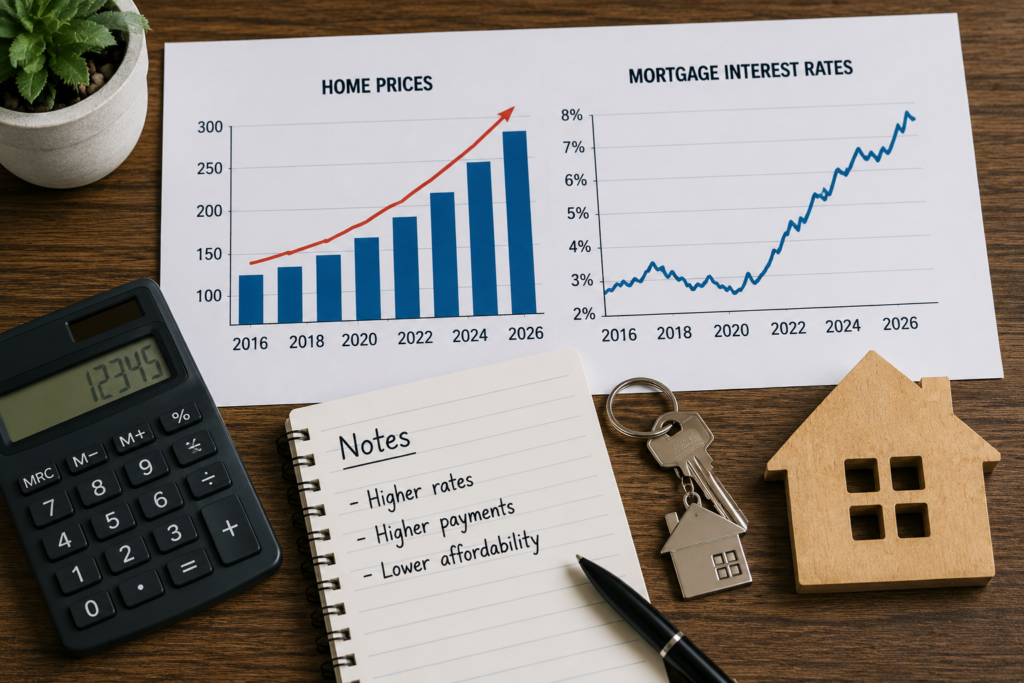
For many investors, the current market feels unusually difficult because it combines two challenges at the same time. Higher interest rates increase borrowing costs, while higher home prices increase the amount of money required to purchase a property. Either challenge by itself can make investing more difficult. Together, they create an environment that can feel discouraging, especially for new investors.
A few years ago, investors benefited from historically low interest rates. Even when property prices increased, low financing costs helped offset some of the impact. Investors could often qualify for larger loans and maintain reasonable monthly payments. Today’s environment is different. Higher rates mean that even if two investors purchase the exact same property at the same price, the investor borrowing at today’s rates may have significantly higher monthly expenses.
This shift has forced many investors to reevaluate how they analyze deals. Properties that may have appeared attractive during a low-rate environment may no longer produce the same results. Investors can no longer rely as heavily on appreciation or favorable financing to make the numbers work. Instead, they must focus more closely on cash flow, expenses, reserves, and long-term sustainability.
At the same time, the current market has created opportunities that are often overlooked. When borrowing costs increase, some buyers step away from the market entirely. As competition decreases, investors who remain active may have more negotiating power and more time to evaluate opportunities. While today’s market is certainly more challenging in some ways, it can also reward patience and discipline.
Many new investors spend so much time focusing on what has changed that they fail to recognize what has remained the same. People still need housing. Rental demand continues to exist. Properties still generate income. Mortgages are still paid down over time. Equity can still be built through ownership. The fundamentals that have made real estate attractive for generations have not disappeared simply because market conditions have become more difficult.
The Real Cost of Waiting for Better Conditions

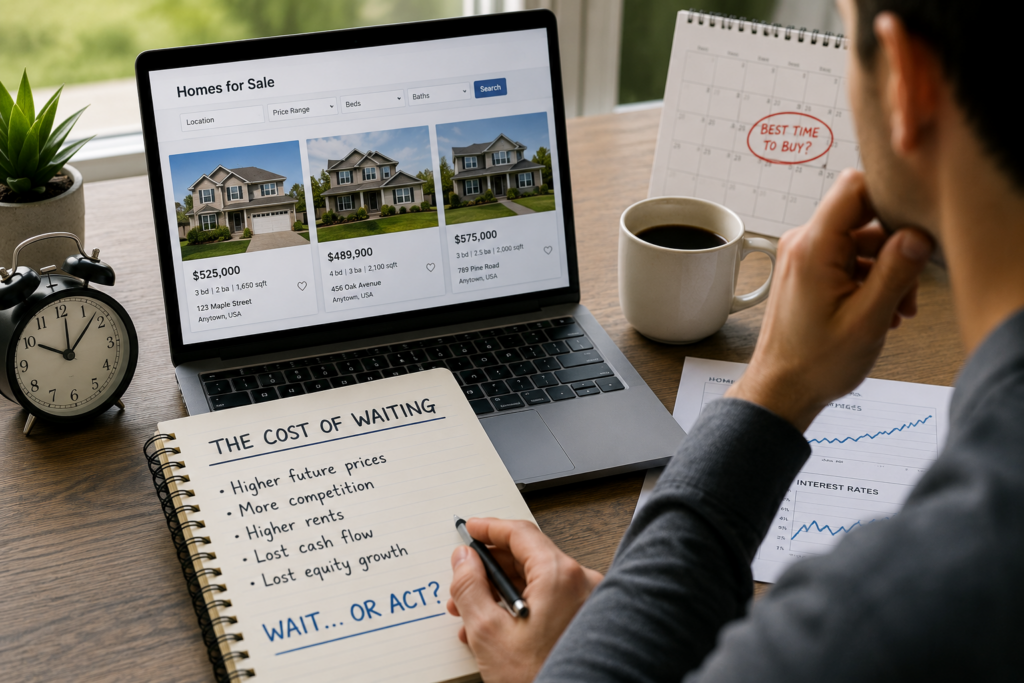
One of the most common responses to today’s market is to wait. Many investors are choosing to delay purchasing properties until interest rates fall, home prices decline, or more favorable opportunities become available. On the surface, this approach makes sense. Why purchase today if conditions may improve tomorrow?
The challenge is that nobody knows exactly what tomorrow will look like. While interest rates may eventually decrease, there is no guarantee that home prices will follow the same path. In fact, lower rates often encourage more buyers to enter the market, which can increase competition and place upward pressure on prices. An investor who waits for lower rates may find themselves competing against far more buyers than they would face today.
There is also an opportunity cost that comes with remaining on the sidelines. During the waiting period, investors may miss years of rental income, principal reduction, and equity growth. While these benefits may not seem significant in the short term, they can become meaningful over longer periods of ownership.
This does not mean investors should rush into purchasing properties that do not make financial sense. Careful analysis remains important regardless of market conditions. However, there is a difference between being patient and attempting to perfectly time the market. History has shown that accurately predicting market movements is difficult, even for experienced professionals.
Many successful investors eventually realize that there is rarely a perfect time to buy. There are simply markets with different advantages and disadvantages. Some markets offer low interest rates but high competition. Others offer more negotiating opportunities but higher financing costs. The key is understanding the environment you are operating in and making decisions based on realistic expectations rather than waiting for perfect conditions that may never arrive.
Cash Flow Has Become More Important Than Appreciation
One of the biggest lessons investors are learning in today’s market is the renewed importance of cash flow. During periods of rapidly increasing home values, appreciation often became the primary focus. Investors were encouraged by rising property values and growing equity, sometimes placing less emphasis on monthly cash flow.
There is nothing inherently wrong with appreciation. In fact, appreciation has helped many investors build substantial wealth over time. The challenge is that appreciation is difficult to predict and impossible to guarantee. Markets move in cycles, and property values do not always increase at the same pace.
Higher interest rates have encouraged investors to return to fundamentals. When financing costs increase, it becomes more important for a property to generate sufficient income to cover expenses and produce a reasonable return. Investors must carefully evaluate rents, maintenance costs, insurance premiums, taxes, vacancy assumptions, and capital reserves. The margin for error often becomes smaller when borrowing costs are higher.
This shift is not necessarily a negative development. In many ways, it encourages healthier investing habits. Properties that generate positive cash flow can provide stability regardless of short-term market fluctuations. Investors who focus on strong fundamentals may be better positioned to withstand periods of uncertainty than those relying primarily on appreciation.
For newer investors, this environment can serve as a valuable reminder that successful real estate investing has always been about more than rising property values. A well-managed property that produces consistent income can remain a strong investment even during periods when appreciation slows.
How Successful Investors Adapt to Changing Markets

One characteristic shared by many successful investors is their ability to adapt. Market conditions are constantly changing, and investors who expect conditions to remain favorable forever often find themselves disappointed. The most successful investors understand that flexibility is part of the process.
Today’s investors may need to analyze more properties before finding one that meets their criteria. They may need to negotiate more aggressively, adjust their expectations, or consider opportunities they previously overlooked. Some may choose to expand their search into different neighborhoods or property types. Others may focus on improving operational efficiency within properties they already own.
Adaptability does not mean abandoning sound investment principles. It simply means recognizing that strategies must evolve as market conditions change. The approach that worked exceptionally well during a low-interest-rate environment may require adjustments today.
Experienced investors also understand the importance of patience. Not every property deserves an offer, and not every opportunity is worth pursuing. In competitive markets, patience can prevent costly mistakes. In slower markets, patience can create opportunities that would not have existed otherwise.
Rather than focusing on factors outside their control, successful investors often concentrate on improving the variables they can influence. They continue learning, analyzing opportunities, building relationships, and refining their decision-making processes. These efforts may not generate immediate results, but they often pay dividends over time.
Real Estate Remains a Long-Term Investment

One reason real estate continues to attract investors despite changing market conditions is its long-term nature. Unlike many investments that are evaluated on a daily basis, real estate often produces results over years and decades rather than weeks and months.
When investors focus exclusively on current interest rates or today’s home prices, they sometimes lose sight of the broader picture. A property purchased today may be owned for ten, fifteen, or twenty years. During that time, market conditions will likely change multiple times. Interest rates will rise and fall. Housing demand will fluctuate. Economic conditions will improve and weaken.
Throughout these cycles, real estate ownership can continue to provide benefits. Mortgage balances are gradually reduced. Rental income may increase over time. Property values may appreciate over longer periods. Owners gain experience, improve operations, and build equity.
This does not mean every investment will be successful or that market conditions should be ignored. Rather, it highlights the importance of maintaining a long-term perspective. Short-term challenges often feel less overwhelming when viewed within the context of a much longer investment horizon.
Many investors who built successful portfolios did not begin under ideal circumstances. They purchased properties during recessions, periods of inflation, high-interest-rate environments, and uncertain markets. What often mattered most was not the condition of the market when they started, but their ability to remain disciplined and committed over time.
As investors evaluate today’s market, it is important to recognize both the challenges and the opportunities that exist. Higher interest rates and elevated home prices have unquestionably changed the landscape. Deals that worked a few years ago may no longer make sense today, and investors must be more selective than they were in the past.
At the same time, real estate remains fundamentally tied to a basic human need: housing. People continue to rent apartments, purchase homes, and seek places to live regardless of broader market conditions. While market cycles influence investment performance, they do not eliminate the underlying demand for housing.
Whether real estate is worth investing in today ultimately depends on an individual’s goals, financial situation, risk tolerance, and ability to find opportunities that align with their objectives. For some investors, waiting may be the appropriate decision. For others, today’s market may still offer worthwhile opportunities despite the challenges.
The most important takeaway may be that decisions should be based on careful analysis rather than headlines alone. Markets will always provide reasons to be cautious and reasons to be optimistic. Understanding both perspectives allows investors to make thoughtful decisions that reflect their personal circumstances and long-term goals. While today’s market may not be easy, it continues to offer lessons, opportunities, and possibilities for those willing to approach it with patience, discipline, and realistic expectations.